Sue and Coops are preparing for their first formal contact with Wentworth. The aim is to confirm the Change Agent and secure their assistance to initiate a Journey of Discovery. In the first stage of Discovery, Sue and Coops will focus on understanding all the ‘current state’ issues, problems and implications. In the later second stage they will strive to disrupt the prospect’s thinking and lead them to a discovery that establishes a new paradigm delivering great value for Wentworth and differentiating Tesico’s offering.
Methods applied
From Doug’s journal, Sue and Coops have learned to develop the following:
- Opportunity Synopsis — a synopsis of the opportunity from the buyer’s perspective, essential to focus on the client and away from us and our offering.
- SWOT — an important part of a sales deal strategy, analysing both customer and supplier strengths, weaknesses, opportunities and threats.
- Competitive Analysis — the best way to compete is to take the lead via your Discover and Disrupt strategy. We must still research key competitors, understand their value proposition, and prepare a strategy to protect our position — a SWOT on their position is a useful tool.
They have also begun to develop informal analytics: a Gap Discovery, and a Stakeholder Map. Refer to your own copy of the Archetype Cards (download them at edvance.sale/archetypes if you haven’t already).
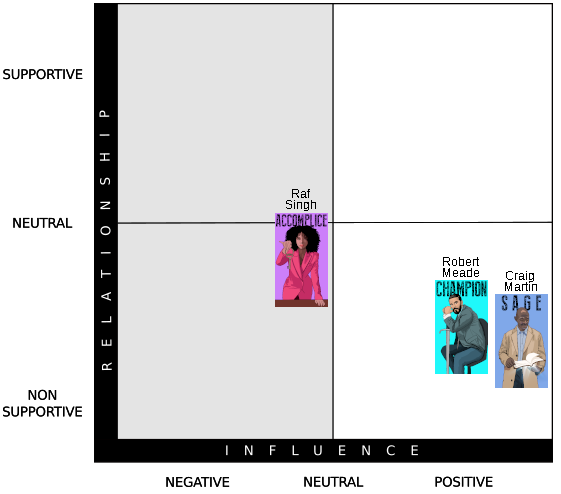
At this stage Sue has elevated Raf Singh to neutral and believes him to be an Accomplice. She and Coops are unsure of the archetypes for the CISO Robert Meade and CEO Craig Martin, though their best guess is Champion and Sage respectively. They have no idea about the CIO Peter Ludick.
Storytelling
Telling stories throughout the sales process is a powerful way to help the customer through their buying journey, build trust, and progress the disruptive thinking journey. Before her first meeting, Sue also needs to prepare some Sales Stories, including a Personal Story and perhaps a Company Story or Story of Key People. Sales storytelling expert Mike Adams calls these ‘Connect’ or ‘Hook’ stories:
- A Personal Story tells the customer who you are, what you do and what you believe. Include failures as well as successes; it lets you ask ‘what about you?’ and helps the customer develop a personal bond and reveal their Stakeholder Archetype.
- A Company Story — how the company came to be, whose inspiration started it, its values, and the difficulties it faced. Turn the question to your customer’s company at the end.
- The Story of Key People in your organisation, helping the customer understand its scope and size and engendering trust in senior staff.
We recommend reading ‘Seven Stories Every Salesperson Must Tell’ by Mike Adams for more on why these stories matter and how to structure them. See a little of Mike in this short video:
Some questions for you
Think back to the customer you want to pursue.
- What would the Opportunity Synopsis look like for them?
- What would the SWOT analysis look like for them?
- Do you know who your competitors are? What would the Competitive Analysis look like?
- Have you been able to identify likely Change Agents?
The Wentworth Prospect
Continue reading from Chapter 14, ‘Monday Morning Blues’.
Don't have the book yet? Get it at Amazon or your favourite retailer.