Sue and Coops have learned that their target prospect (Wentworth) operates within an existing paradigm where security is defensive and driven by hackers — one that also presents future business risks and lost opportunities. The intended outcome of the ‘E’ of EDVANCE is for the prospect to agree to a process of Discover and Disrupt, the ‘D’ of EDVANCE, where the status quo may be challenged and the prospect motivated to investigate further. Reasons to change the paradigm must be presented so that the prospect discovers them themselves and is prompted to see the positive side of the risk/reward equation.
Methods to apply in this stage of ‘Engage’
At this stage, Sue and Coops need Wentworth’s agreement to conduct a Journey of Discovery. They can only move to this step after gaining a commitment from the customer, and will likely need the assistance of a Change Agent. They believe Raf is an Accomplice only (one of the Advocate archetypes) but hope he can introduce them to a Change Agent.
Following ENGAGE, the next step is D for DISCOVER AND DISRUPT, which contains two stages:
- Discover — often called ‘Down the Hole’: investigating the current state, the situation, the problems and their implications.
- Disrupt — often called ‘Up the Hill’: developing a desired state by helping the customer through a thinking journey to a new awakening about how to achieve their desired outcomes.
Sue and Coops’s first step was to propose a discovery journey they’ve shared with Raf. This is step one of Discover and contains no details of the Tesico product — the customer is only interested in understanding their issues and implications. The proposed outline includes the following ‘current state’ questions:
- Precise nature of the attack.
- Current protection arrangements (strengths and weaknesses).
- Detailed information on the damage caused.
- Which departments were affected? Are other areas affected?
- Does everyone at Wentworth view the threat the same way?
- Whose decision will it be to change the current security arrangement?
- What are their formal decision criteria?
- What are their informal decision criteria?
- What are the risks associated with the current arrangements?
- What would be the consequences of inaction?
To answer these, the proposal also requests interviews with executives responsible for the security arrangements, executives in indirectly-affected areas, and their direct reports if not available.
Sue and Coops have also begun the Stakeholder Map.
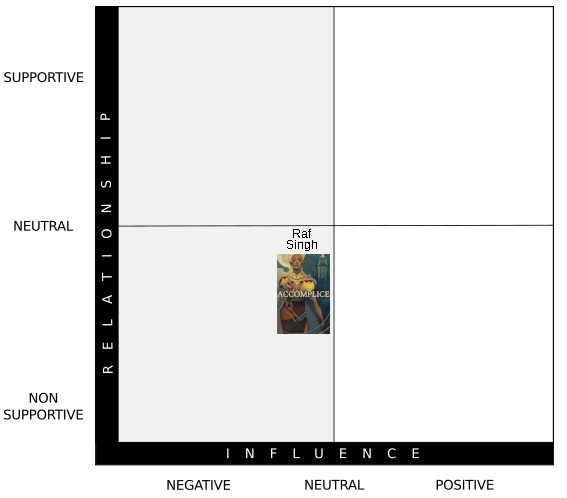
At this stage they are only able to map Raf Singh; Sue believes his archetype to be an Accomplice. Refer to your own copy of the Archetype Cards, or download them here.
Some questions for you
Think back to your current target prospect.
- Who are your main contacts?
- Would you class them as people with the power to drive consensus for your proposal (Change Agents)?
- Or as supportive and friendly, but with no real influence to drive change (Advocates)?
- Draw up your own Stakeholder Map as instructed here, then plot these stakeholders on it.
- If they are Change Agents, are they in the upper-right quadrant where they support your proposal? If not, how will you move them?
- If they are Advocates, where do they sit on your map?
- How can your Advocates help you gain access to a Change Agent?
- Have you identified a Champion yet?
- Do you have access to all Change Agents who are stakeholders? If not, why not, and how can you help your Champion gain consensus?
The Wentworth Prospect
Continue reading from Chapter 11, ‘A Question of Trust’.
Don't have the book yet? Get it at Amazon or your favourite retailer.