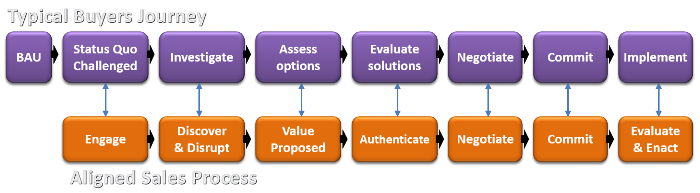
The DISCOVER AND DISRUPT step aligns with the INVESTIGATE step in the buyer’s journey.
Sue has regained access to a Change Agent (Robert Meade) through her Accomplice (Raf Singh). The trust Sue had built with Raf gave him the confidence to risk another engagement with Meade. During the meeting Sue did not rush, and did not move quickly into questioning — she used the meeting to build rapport.
Sue and Coops have identified Meade as a CHAMPION archetype because:
- He is motivated by the ‘greater good’ and seeks organisational rather than personal success.
- He is a protector, evidenced by his defence of the CEO, Craig Martin, and concern for Wentworth’s values.
- His willingness to arrange interviews with both the project team and Decision Making Unit shows his position as a Change Agent.
- He is a practical, hands-on manager interested not just in the idea but the process through which it is realised.
Refer to your own copy of the Archetype Cards (download them at edvance.sale/archetypes if you haven’t already). They have also identified the CEO, Craig Martin, as a SAGE archetype because he is passionate about ideas and sees their potential, is a communicator and teacher able to spread enthusiasm, and is a big-picture thinker who is less hands-on than the Champion.
Sue has now received an unofficial agreement to begin a Journey of Discovery for Wentworth. Throughout this journey she must take a deep dive of discovery and then disrupt the prospect’s current thinking to establish a new paradigm. This stage coincides with the INVESTIGATE stage of the buyer’s journey.
Methods applied
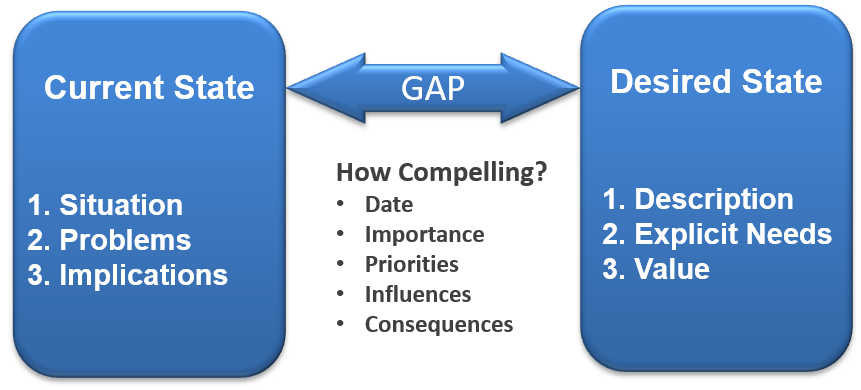
Sue will apply the discovery process defined by Doug. There are two stages and five tactics in a well-constructed ‘discover and disrupt’ process:
- Current State: what currently is? (Down the Hole)
- Tactic 1: ‘What is?’ questions — physical, intellectual and emotional.
- Tactic 2: ‘What caused?’ questions — who, what, when, where?
- Desired State: what might be? (Up the Hill thinking journey)
- Tactic 3: ‘Why?’ and ‘Why not?’ questions and stories.
- Tactic 4: ‘What if?’ questions and stories, and ‘What value?’ questions.
- Bridge the Gap
- Tactic 5: ‘How compelling?’ questions.
Sue has begun to understand the buying process Wentworth will adopt:
- A project team created by the CISO, Robert Meade, will look into the attacks, identify the problems with the current state, and recommend a course of action via a white paper.
- Robert Meade will present the white paper to the Decision Making Unit (composed of high-ranking C-suite executives), who make the final decision.
The DISCOVER and DISRUPT process must begin with the project team, focused on the ‘current state’. She will not discuss solutions but will try to discover the problems Wentworth faces — this is where she will try to drive consensus. Project team: Raf Singh (IT Security Manager, Accomplice archetype); Sally McCrae (Customer Experience Manager); Bryce Nichols (Senior Operations Manager). Once the DMU is announced, Sue will attempt to interview them too.
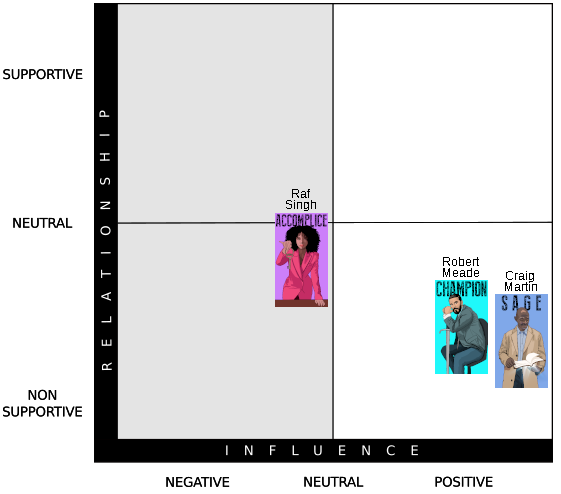
With guidance from Doug’s notebook, Sue and Coops have updated the Stakeholder Map.
Sue has also identified a potential hidden criterion: fear of personal fines and imprisonment for negligence is a motivating factor.
Some questions for you
Think back to your current target prospect.
- Which stakeholders are best placed to help with Discovery, and why?
- Have you begun interviewing them? Have you started a deep-dive discovery?
- Have you been talking about solutions? Try bringing conversations back to problems and challenges first — this is where you drive consensus.
- Do you know their formal and informal decision criteria, and how their organisation makes decisions?
- What are the risks of the current arrangements, and the consequences of inaction?
- Do you have the assistance of a Change Agent yet? If not, how will you find one through an Advocate?
- Have you thought about how you might take them on a thinking journey that disrupts their entrenched views?
Now map your current stakeholders, showing any movement in influence or relationship.
The Wentworth Prospect
Continue reading from Chapter 21, ‘View From the Inside’.
Don't have the book yet? Get it at Amazon or your favourite retailer.