‘Commit’ explained
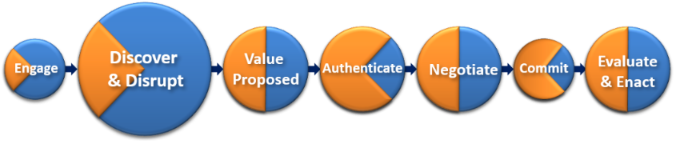
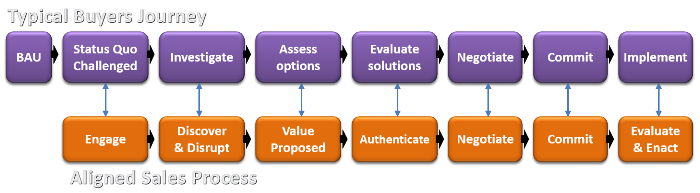
The purpose of the COMMIT phase is that both parties commit to implementing the solution, usually through a formal agreement such as a contract. There may be incremental agreements to be met before a buying decision is made. If the EDVANCE process is followed, gaining commitment at each stage and at the end becomes a natural process. Consider what is needed for a successful commitment, the best time to ask, and what different requirements need to be addressed and when. The COMMIT step aligns with the COMMIT step in the buyer’s journey.
‘Evaluate & Enact’ explained
The EVALUATE & ENACT step is not covered in the novel, yet it is a very important step — the logical conclusion of the EDVANCE process. If all steps have been followed, a contract is signed and all incremental agreements made, the process flows naturally to delivery and implementation. EVALUATE & ENACT aligns with the IMPLEMENT step in the buyer’s journey.
The methods applied
Commit
Sue has first addressed all lingering doubts and objections in the negotiation phase, trading two relatively low-impact concessions for two high-impact rewards. Wentworth has agreed to her proposals, and the stage is set for COMMIT — what many call the ‘close’. We call it commit because it is what we do together with the client: we commit to each other. EDVANCE is a partnership model that is open and transparent — we are not doing anything to the customer, we are collaboratively working with them toward a mutually beneficial outcome.
The transition to COMMIT is critical. If lingering doubts remained, Sue would still be in NEGOTIATE. To be sure of her ground, Sue has questioned her prospect for clarification:
- At the Esperance Hotel, Sue asks Robert Meade: ‘So negotiations are concluded?’ He replies that they are.
- Sue seeks further confirmation: ‘And Wentworth is ready to proceed with our proposal?’ Robert Meade confirms.
- As a natural progression, the contract is signed.
From there, Sue and her team will build their proof-of-deployment model, demonstrate feasibility, then move into ENACT as full deployment goes ahead.
Enact
Although not covered in the book, ENACT is a critical stage determining the success of the implementation and the acquisition of future business. The salesperson is normally highly trusted at this point, and the last thing the customer wants is to see them leave. The salesperson is accountable for ensuring a smooth transition to the delivery and implementation team, and should continue to meet regularly with the DMU. Too often salespeople disappear to chase new business and the customer feels deserted.
Evaluate
In parallel with ENACT we should EVALUATE our performance. B2B sales requires a big investment in resources; win or lose, we must learn from the process and continuously improve. Because of that investment, we have also earned the right to get feedback from our customer — don’t forget the win-loss review. There are experts who can help, such as Trinity Perspectives.
Some questions for you
- Think of your prospect once more. Do you know exactly where you both stand?
- Are there lingering doubts on either side? If yes, you are still in NEGOTIATE. If no, you might be ready to COMMIT.
- Have you asked for their informal commitment (‘Are we ready to proceed?’)?
- Have you gained formal commitment by way of a contract?
- Then you are ready to ENACT, the final step. Ask for the commitment — close. You have earned it.
- What have you learnt from recent opportunities — the ones you lost, and just as importantly the ones you won?
The Wentworth Prospect
Return to the book at Chapter 53, ‘New Horizons’, for the conclusion to The Wentworth Prospect.
Don't have the book yet? Get it at Amazon or your favourite retailer.