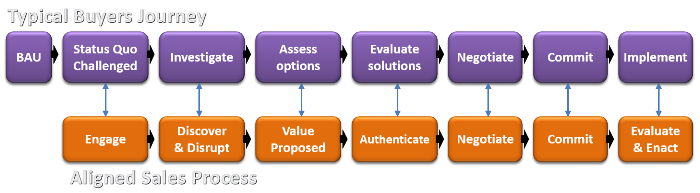
The purpose of the NEGOTIATE step is to seek out and address any remaining concerns that block the path to a signed contract. Broadly, you must actively seek out remaining objections, treat objections as opportunities, understand them fully and what they genuinely mean, and propose solutions, discuss and seek agreement.
Negotiation is about understanding the position of the other party, not pushing your own agenda. A deal can break down here because the customer’s deep-seated needs have not been answered, or you have not made your own situation clear. Negotiation is never a compromise or ‘meeting in the middle’ — it is about achieving the best possible deal for both parties. A ‘win-win’ needs a thorough investigation of both parties’ needs. The NEGOTIATE step aligns with the NEGOTIATE step in the buyer’s journey.
Methods applied
With the help of Doug’s notebook, Sue has planned for NEGOTIATE by:
- Establishing which concerns her prospect may bring as a bargaining chip — in Wentworth’s case, a potential repeat of the deployment delays experienced by China Prestige.
- Identifying both the low-impact and high-impact concessions she may need to make.
- Identifying the low-impact and high-impact concessions Wentworth is able to make.
- Establishing a ‘walk-away point’ — the absolute limit of her negotiation range, beyond which the deal is worth nothing to Tesico.
- Identifying Wentworth’s walk-away point and negotiation range.
- Considering which low-impact concessions from Wentworth would deliver high-impact rewards for Tesico, and vice-versa. She will offer a low-impact concession (a go/no-go clause) for a high-value reward (a contract). From Wentworth’s view, a low-impact concession (a contract they can exit) for a high-impact reward (proof of successful deployment).
- In relation to Wentworth’s insistence on penalties, exchanging her lowest-impact concession (50% of the API build) for a high-impact reward (guaranteed first-year profit).
Tesico and Wentworth have arrived at a position where they need each other more than they perhaps admit. Sue understands this but, unlike Roper, doesn’t push too hard: she makes her position known but negotiates in an atmosphere of partnership and mutual trust, always with the customer’s concerns in mind. With Doug’s notebook she has also understood:
- Determine the order of concessions (lowest-impact first).
- Never offer a concession without getting something in return. Concede slowly.
- Don’t feel the need to answer or suggest — silence can be powerful.
- Turn single issues into multiple issues to create room to negotiate.
- Insist on one condition depending on another (your low-impact concession for a high-impact reward).
- Always say ‘If you will… then I might consider…’, never the other way round.
- Never say ‘no’; say ‘that depends’.
- LISTEN to proposals carefully, CONSIDER them in light of what they mean for the customer, RESPOND with counter-proposals.
- Be wary of responding to on-the-spot objections — you’ll seem defensive and need time to formulate the right response.
- Seek objections face-to-face to read emotions and signals. Treat emotional arguments as real.
- Make sure all concerns are addressed: nothing is agreed until everything is agreed.
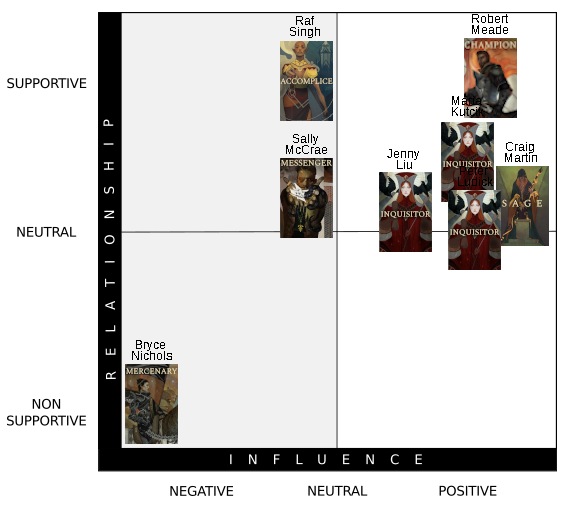
Stakeholder map
Sue has updated the Stakeholder Map at this point. Do you agree with her reckoning?
Some questions for you
- Does your prospect still have lingering concerns? What are they?
- Can you identify which real concerns your prospect will bring to the negotiation? Any imagined concerns?
- Have you considered all potential trades to address these concerns? List them, then order them low to high impact — this forms your negotiation range.
- What is your walk-away point, your negotiation ceiling?
- Do you know the concessions your prospect might make, and their walk-away point?
- Which low-impact concessions for them would offer a high-impact reward for you, and vice-versa?
- Link these concessions — this forms your strategy for a win-win negotiation.
The Wentworth Prospect
Continue reading from Chapter 52, ‘Grab the Sauce’.
Don't have the book yet? Get it at Amazon or your favourite retailer.