Welcome to the online companion to the book ‘The Wentworth Prospect’.
Together, the novel and this online companion will help you gain a comprehensive understanding of the EDVANCE sales framework that our heroine, Sue Novak, and her team deployed in the novel. EDVANCE aims to equip you with the skills and capability for success in today’s business-to-business environment. It can help you become a more effective salesperson, and navigate the biggest deals of your career.
This online companion contains detail on the practical steps of EDVANCE. The novel will help you understand how these steps may be applied in a real world scenario. Further, this online course will examine how EDVANCE can be used by you, in your business and with your own prospects.
By following the links in the book and the instructions on these webpages, you will be guided through the entire EDVANCE process. Navigation is provided at the top and bottom of each page for your convenience.
An introduction to the EDVANCE process
From Doug’s notebook, Sue has learned of a structured approach to business-to-business (B2B) selling, given its structure by a process named EDVANCE:
- E — Engage
- D — Discover and Disrupt
- V — Value Proposed
- A — Authenticate
- N — Negotiate
- C — Commit
- E — Evaluate & Enact
In Doug’s notes he had depicted EDVANCE in a diagram of circles and pie charts.
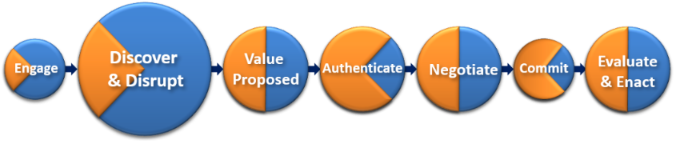
- The circles indicate the proportion of time the salesperson should invest in that stage of the sales process, assuming the previous stage has been satisfactorily completed. Moving to the next stage too early is likely to delay the sale, or at worst cause it to be lost.
- The orange indicates the percentage of time the salesperson should be talking during discussions with the prospect, versus the percentage of time the prospect should be talking, in a well managed sales conversation at that stage.
The purpose of the book is to explain EDVANCE and why it is the right way to sell. In summary, it provides a stepped approach that helps the salesperson focus their attention on the customer and the customer’s desired outcomes. The objective is to help the customer think through how to address a challenge or problem in a way in which the salesperson can then deliver a differentiated solution.
A trigger event has occurred — Wentworth has been hacked. This prompted Sue to start the ENGAGE step at Wentworth by reaching out to Raf Singh by phone, voicemail and text. Salespeople should use all available channels to reach prospects with customer-oriented, interest-creating messages that are business-oriented and not product-related.
Sue will need to conduct significant research so that she leverages her knowledge of the industry and its issues when approaching target executives at Wentworth. She must ensure her messaging is aligned to their specific situation and that she is ready to ask insightful questions.
An introduction to the buyer’s journey
Sue has also learned the importance of understanding the Buyer’s Journey. Here’s how it typically looks:
- Business as usual — the buyer is unaware of a problem or need, and may be unaware of you. If they are an ideal client we need to begin engaging with them by delivering the right content, to the right target, at the right time.
- Status quo challenged — something has triggered the customer to start thinking about change, or you may have sown a seed. They acknowledge it must be addressed.
- Investigate — the buyer investigates the issue to determine the root cause, often engaging peers and industry experts.
- Assess options — they assess the different ways the issue can be addressed and the ROI of each, then choose a preferred approach.
- Evaluate solutions — they investigate vendor offerings, compare their consideration set, and shortlist or select a preferred supplier.
- Negotiate — before deciding, the buyer considers cost, support options and risk management.
- Commit — the buyer is ready to commit, if they trust you, your company and your solution.
- Implement — your solution is implemented; you assist with change through enablement and training.
As Doug’s manuscript points out, the traditional sales process and the buyer’s journey are regularly misaligned:
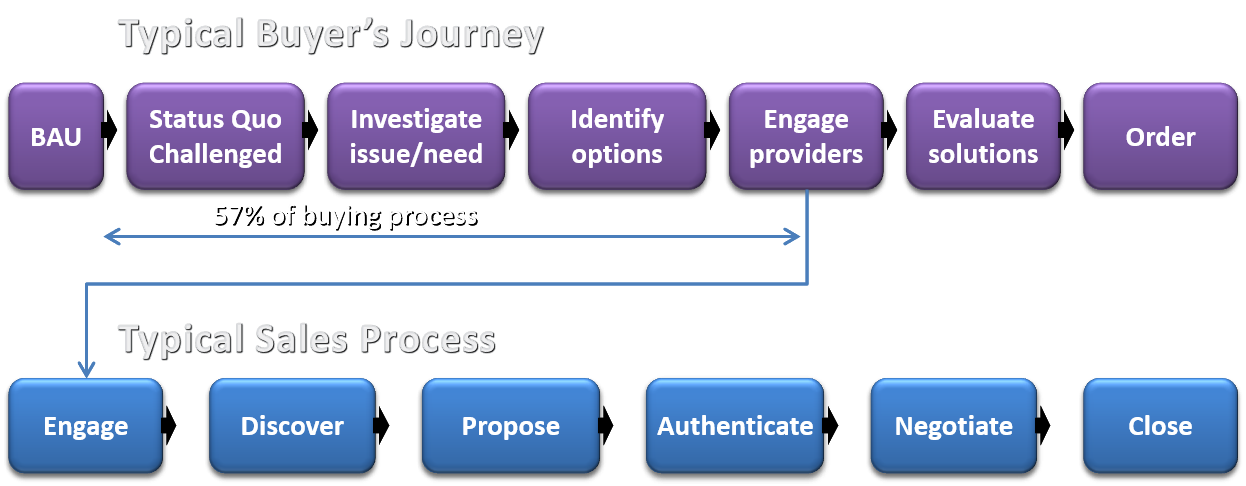
In this example the salesperson only enters when the buyer is ready to evaluate vendor solutions — often sixty percent or more through their journey. By then the buyer has decided on an approach and is running a side-by-side analysis. You cannot significantly influence the solution design; you have been relegated to supplier status.
The solution, as outlined in EDVANCE, is to begin the first step (ENGAGEMENT) as early as possible, so the buyer’s journey and the sales process are aligned:
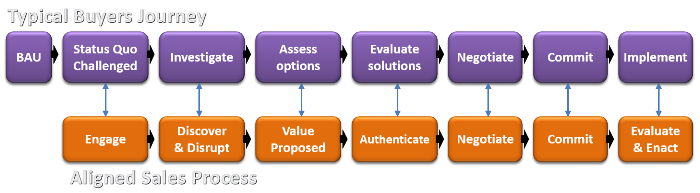
Early engagement is the first step in the EDVANCE process, and is covered in greater detail later in the book and in these companion pages.
Some questions for you
To better understand how these methods might assist you, make some notes and answer the following:
- Have you experienced entering the buyer’s journey too late? If so, with which customers?
- At what stage did you enter the buyer’s journey?
- What challenges did this present in progressing the sale and ultimately gaining an order, or not?
- How could it have been different if you had entered earlier?
- Have you experienced engaging early in the buyer’s journey? How was that different?
- What trigger events have you observed, and how did they impact your prospect’s status quo?
- Do you have targeted accounts recently impacted by a trigger event who might be starting to think about change? Keep them in mind as we progress.
The Wentworth Prospect
To see how EDVANCE is employed in a real-life scenario, return to the book and continue reading from Chapter 7, ‘The Unseen Mentor’.
Don't have the book yet? Get it at Amazon or your favourite retailer.