Hover over a card (or tap on mobile) to read what drives each archetype.
Change Agents
The first three archetypes — Champion, Sage and Inquisitor — have the ability to lead, drive consensus and inspire others to follow. These are the stakeholders the salesperson should target. Of them, the Champion alone has the capability to gain consensus to commit to your proposal.
Champion — Change Agent
The most powerful of the Change Agents. Not only do they have the influence to drive consensus for your proposal internally, they also have the resource and ability to turn plans into reality.
Focuses on Getting the job done. Responds to Organisational success · methodology for delivery.
Motivated by ‘the greater good’, the Champion is a fearless supporter of ideas that deliver results, regardless of where they come from. Often a highly respected leader, they can rally support for a proposal they deem worthy. Always in the thick of the action, they see a project through to the end. Your greatest supporter — but a formidable enemy if negatively disposed.
Champion
Sage — Change Agent
A powerful Change Agent. Through personality or position, they have the influence to inspire consensus for your proposal, though they may lack the resource or ability to implement.
Focuses on Communicating the idea. Responds to The big picture · scope of possibility.
A visionary who seeks to understand the power of an idea. If the Sage sees true potential in a proposal, they become an inspiring communicator, driving enthusiasm by painting vivid pictures of the possibilities. As ideas-people, they often lack the practical ability to turn ideas into reality. If negatively disposed, they can spread dissatisfaction, discord and distrust.
Sage
Inquisitor — Change Agent
A powerful Change Agent. Through personality or position, they have the influence to drive consensus for your proposal, though they may lack the resource or ability to implement.
Focuses on Interrogating the proposal. Responds to The truth · quantifiable evidence.
The Inquisitor will always tear an idea to pieces before acceptance — they want to pressure-test and examine. Their tendency to over-scrutinise is often not a sign of non-acceptance but that they are engaged and want to understand fully. Conversely, if they fail to question your proposal, they may have quietly dismissed it, or may try to discredit it through hostile questioning.
Inquisitor
Advocates
The last three — Accomplice, Messenger and Mercenary — have limited ability to make decisions or drive consensus. That said, each can still help on an individual basis, assisting you to gain important information and to influence the Change Agents.
Accomplice — Advocate
A useful Advocate. While they lack the authority to drive consensus for your proposal personally, they may assist in paving the way to a Change Agent who can.
Focuses on Helping others to a solution. Responds to Open dialogue and relationships.
Always happy to meet, talk and connect, the Accomplice is a helpful networker. Friendly and forthcoming, but their influence to drive consensus is limited. As a networker they likely have the ear of a Change Agent and may introduce you if supportive. In their negative aspect, they will assist your competitor, block your path to a Change Agent, or turn them against you.
Accomplice
Messenger — Advocate
A useful Advocate. They lack the authority to drive consensus personally, but may provide privileged information or promote your proposal within their organisation.
Focuses on The control of information. Responds to Gossip · being ‘in the know’.
The Messenger believes that ‘information is power’, and seeks to control its flow between their organisation and outsiders in both directions — often making up for a lack of real influence. They love gossip and may reveal information not typically available to outsiders. When negatively disposed, they use information about you to undermine your proposal from within.
Messenger
Mercenary — Advocate
A useful Advocate. Although they lack the authority to drive consensus personally, they may assist you if they believe your proposal furthers their own cause.
Focuses on ‘What’s in it for me?’. Responds to Vanity · personal advancement.
The Mercenary is loyal only to themselves. They care little for their organisation and back only projects offering personal gain or career advancement, opposing those that threaten them. Difficult to detect, but often revealed by colleagues or a tendency to talk about themselves. If negatively disposed, a dangerous adversary — working openly, or more likely covertly, against you.
Mercenary
A word of warning
Each archetype can be positive, neutral or negative in their relationship with you and your proposal. A non-supportive Change Agent effectively becomes a ‘blocker’; a non-supportive Advocate is adept at undermining your proposal from within. Read each stakeholder’s disposition as carefully as their type.
Stakeholder Mapping
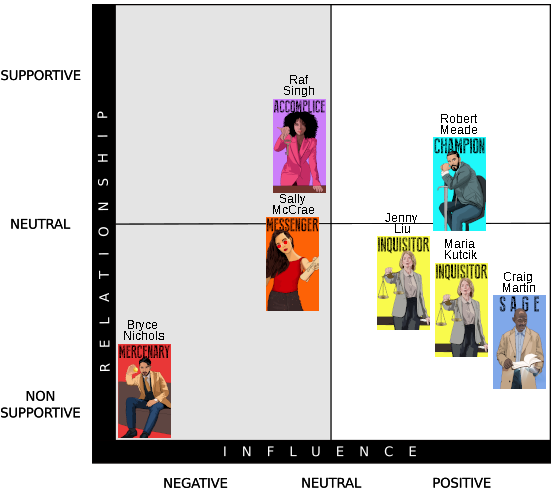
Each archetype differs in the amount of influence they hold within their organisation and in their relationship with you. Plot each stakeholder against two axes: Influence (horizontal) and Relationship (vertical).
A stakeholder’s ability to influence others ranges from negative to positive along the Influence axis. Advocates rarely influence their organisation beyond the neutral mid-point; Change Agents have the authority to drive organisation-wide change. The map divides into quadrants — Advocates remain in the grey sections to the left, while Change Agents may be plotted anywhere.
Each stakeholder also ranges from supportive to non-supportive along the Relationship axis. Non-supportive Change Agents become ‘blockers’; non-supportive Advocates undermine from within. For success, aim to move all stakeholders above the central line, and the Change Agents into the upper-right quadrant.