Sue and Coops have concluded initial meetings with the Wentworth Project Team, whose objective is to compile a white paper of recommendations for the Decision Making Unit (DMU). As identified in Chapter 20, the Project Team comprises Robert Meade (CISO), Raf Singh (IT Security Manager), Sally McCrae (Customer Experience Manager) and Bryce Nichols (Senior Operations Manager).
At this point, individual team members hold different views of the current state — the cyber-attack and its impact. Sue and Coops have made a first attempt at profiling all team members with Doug’s Stakeholder Archetype Cards. Through these interviews, Sue has begun to take the prospect on a Journey of Discovery; her task is now to disrupt current thinking and lead them to a new paradigm. This stage aligns with the INVESTIGATE stage of the buyer’s journey.
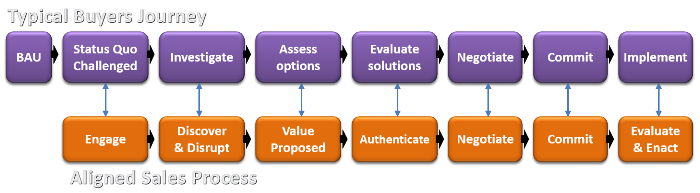
Methods applied
Discovery model
The first stage is to define the Current State (situation, problems and implications). Sue will later take the customer on a thinking journey to a Desired State (explicit needs, benefits and value) that should realise outstanding value and differentiate the Tesico offering. She can then prepare a GAP DISCOVERY to plot the steps toward that desired state and identify why it will be compelling.
There is a lack of consensus surrounding the cyber-attack within the Project Team, because each member has assessed the attack only in light of their own department, and they are not aware of the wider damage to the company or brand. Sue must help her advocates disrupt entrenched views and drive consensus — first on the problems and their implications, which she has identified as:
- Wentworth is unable to innovate in customer service; the firewall has prevented development of new customer products.
- The firewall has prevented the bank from understanding its customers; consumer research has not been shared or has been ignored.
- The bank is losing customers; surveys show dissatisfaction with online service, damaging reputation.
- The bank’s centre of power lies in operations and IT; customer service has been marginalised, so the bank is not customer-focused.
- There is fear within some departments of personal fines and imprisonment for negligence — a motivating factor and potential hidden criterion.
Once the issues are agreed, Sue must encourage Wentworth to paint a picture of their desired state (this comes later, in Disrupt), from which she can help them recognise the VALUE a solution can offer.
Stakeholder mapping
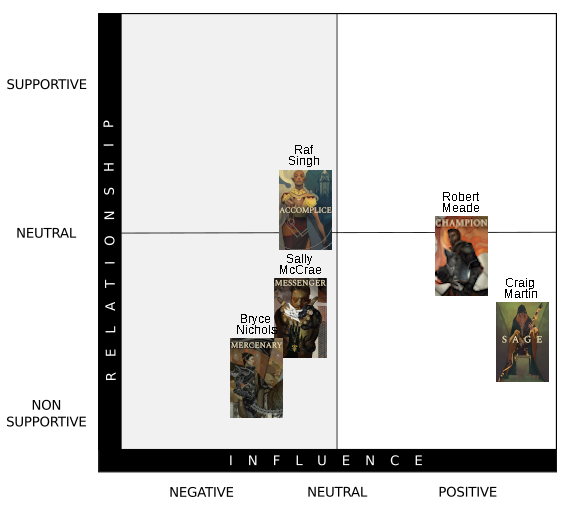
Refer to your own copy of the Archetype Cards, or access them now at edvance.sale/archetypes. Using the cards, they have identified the Customer Experience Manager, Sally McCrae, as a MESSENGER because she lacks the power to drive consensus (therefore an Advocate), is willing to share privileged information, likes to control the flow of information, and likes to be seen as ‘in the know’. They have identified the Senior Operations Manager, Bryce Nichols, as a MERCENARY: his tendencies were disclosed by colleagues, he defaults to his manager the COO Maria Kutcik, shows signs of being a corporate ladder-climber, and likes to talk about himself.
Some questions for you
Think back to your current target prospect.
- What have you learned of their entrenched views?
- Have you identified the problems from a number of different viewpoints?
- Have you dug down to identify the root causes? List them.
- Have you identified the implications of these problems across the organisation?
- How will you drive consensus on the problems? Detail a plan.
- Have you identified their formal decision-making process and criteria, and any informal influences?
- Map any additional stakeholders, showing movement in influence or relationship.
The Wentworth Prospect
Continue reading from Chapter 25, ‘The Evil Empire’.
Don't have the book yet? Get it at Amazon or your favourite retailer.