Sue and Coops have driven a reasonable level of consensus at DMU level on the problems and implications of the current state:
- Substandard network security and increased threat of more cyber-attacks.
- Lack of digital innovation, resulting in dissatisfied customers, account attrition and revenue drain.
- Risk of prosecution for negligence.
These constituted the first stage of Wentworth’s DISCOVERY. The second stage, DISRUPT, aimed to change Wentworth’s assessment of their situation and guide them to a new paradigm — the desired state engineered by Sue with Raf and Meade. Sue has Meade’s agreement that this will influence Wentworth’s requirements in their RFP, and has gained his agreement on the value (business case and ROI) of achieving the desired state. She has detailed how compelling the gap is between the two paradigms, and the steps, risks and rewards, in a gap discovery presented to Meade. Sue will leave it to Meade to gain DMU agreement on the future desired state and produce the RFP. In the next phase, VALUE PROPOSED, she will demonstrate the difference between Wentworth’s current and desired future states. This ends the DISCOVER AND DISRUPT stage.
Methods applied
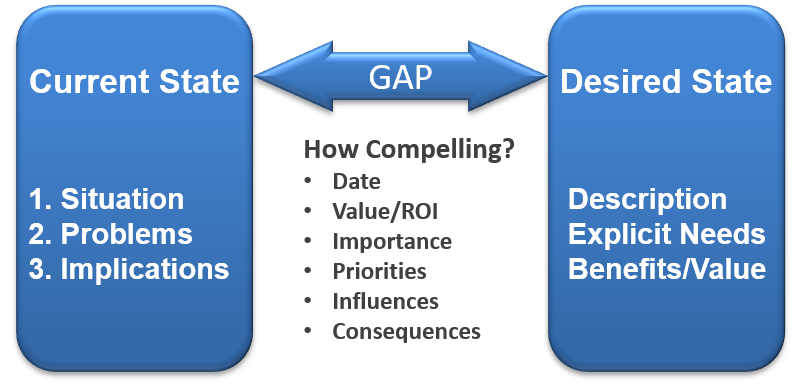
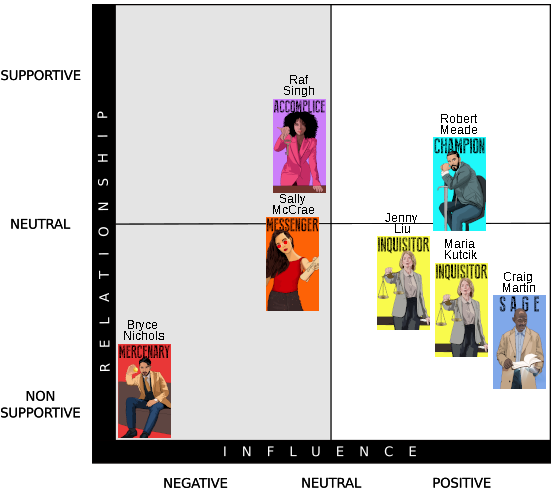
Sue has driven consensus on the current state among the Project Team through the findings of formal research, which clearly identified consumer dissatisfaction with digital innovation. The debrief of the quantitative research helped convince the two INQUISITORS on the DMU, Maria Kutcik (COO) and Jenny Liu (Client Services Director), of the problem and its implications. Sue has also posted a well-researched article on the risks of prosecution for non-compliance with the Notifiable Data Breaches Scheme provisions in the Privacy Act, which secured a further interview with the COO and drove further consensus by making Maria Kutcik and CEO Craig Martin aware of the legal consequences of the CBIS firewall. Sue has still not secured an interview with the CIO Peter Ludick, but now appears to have a majority of consensus within the DMU.
Some questions for you
Think back to your current target prospect.
- Have you helped them uncover all problems and implications of their current state?
- Have they reached consensus on these issues? If not, how will you influence consensus?
- Once majority consensus is achieved, will you be ready to guide the prospect to an agreed desired state?
- How will you take the prospect on this thinking journey without talking about your offering?
- Complete your gap discovery, and agree the value it represents to their business.
- What are the tangible benefits of addressing this value, and for whom?
- How will the business change through realising this value? Can you demonstrate it via gap discovery?
- What are the risks of inaction? Have you confirmed the prospect’s buying criteria and critical success factors?
- Map any additional stakeholders, showing movement in influence or relationship.
Warning: do not proceed to VALUE PROPOSED until you can positively answer all these questions, or the customer is unlikely to understand how your proposal delivers value and your sale is likely to stall.
The Wentworth Prospect
Continue reading from Chapter 38, ‘The Flying Dutchman’.
Don't have the book yet? Get it at Amazon or your favourite retailer.